
Tottenham Driving Test Routes – Local Hazards & Pass Tips (2026)
Preparing for your test in London? Passing at Tottenham isn’t just about driving skill—it’s about mastering the Tottenham driving test routes that often trip learners up. Tottenham is part of the London Driving Test Centres network.
As a senior instructor, I’ve seen many skilled learners fail the Tottenham test. It’s rarely about ability—it’s the local pressure of {Tottenham Hale Gyratory (A503) or A10 Great Cambridge Road. Understanding the Tottenham driving test routes isn’t just helpful—it’s what helps you feel prepared and confident on test day.
Expertly designed by UK Route Master, based on real Tottenham driving test routes. One tap opens in the Google Maps app you already use.
Tottenham Driving Test Centre Information
📍 Location & Facilities
- Address: Selby Centre, Selby Road, Tottenham, N17 8JL.
- Contact: 0300 200 1122 (Official DVSA).
- Toilets: Available
- Waiting Area: Limited indoor space
- Accessibility: Fully accessible for wheelchair users
- Parking: Limited on-site parking is available for test candidates only.
📊 Testing Intel (2025/26)
- Difficulty: Medium-High
- Major Obstacles: Tottenham Hale Gyratory (A503) or A10 Great Cambridge Road.
- Key Skill: Strict lane discipline and anticipation in residential zones.
- Pro-Tip (Best Times): 9:00 am – 11:30 am
- Avoid : 8:00 am – 9:00 am & 3:00 pm – 4:30 pm
⚠️ Essential Candidate Rules
- Arrival: Do not arrive more than 10 minutes early. The car park is compact, and arriving too early causes congestion.
- Book your test via the official DVSA service.
- Change your booking (Give at least 3 working days’ notice to avoid losing your fee).
- Your Vehicle: Private cars must meet DVSA standards (e.g., extra mirror, L-plates, and roadworthiness).
Tottenham Driving Test Routes: Main Roads & Residential Areas
🚦Main Roads & Traffic Flow
- High Road (A1010): A high-pressure artery; stay alert for intense pedestrian activity, constant bus maneuvers, and rapid traffic light cycles.
- The Roundway (A10): A wide dual carriageway requiring perfect lane positioning and smooth transitions between 30mph and 40mph zones.
- Lordship Lane (A4030): A vital central link; demands high vigilance at large multi-lane junctions and strict adherence to bus lane rules.
- Watermead Way (A1055): Utilized for independent driving to evaluate high-speed dual-carriageway merging and 50mph limit compliance.
- Shelbourne Road: The test centre’s immediate exit; requires instant focus on industrial vehicle hazards and narrow gaps.
🏠 Residential & Hazard Areas
- Bruce Grove Side Streets:Densely packed terraced grids used to evaluate “meeting” etiquette and spatial awareness in tight spaces.
- Broadwater Farm Estate: Features wide residential loops designed to test priority judgment at mini-roundabouts and reversing accuracy.
- Tower Gardens: A quieter suburban pocket frequently selected by examiners for observation-heavy roadside tasks like parallel parking.
- Lansdowne Road: A standard residential link used to assess steady speed control and moving off safely from behind parked cars.
- St. Loys Road: A varied route used to test your hazard perception within local school zones and high-density parking areas.
Tottenham Driving Test Local Hazards: Instructor’s Final Checklist
Key hazard points found along common Tottenham driving test routes, reviewed before test day.
✅ The Roundway (A10) Gyratory:
This isn’t just a roundabout; it’s a high-speed system that behaves like a mini-motorway. The #1 fail is losing your “spiral” lane when heading toward the A10 City. If you drift across the white lines without a blind-spot check because the lanes feel wide, it’s an immediate Positioning fault. Stay disciplined within the markings.
✅ Lordship Lane (A109) 20mph Trap:
A notorious stretch immediately outside the test centre. It’s long, straight, and busy, making it easy to drift up to 24mph while scanning for pedestrians. In 2026, examiners are zero-tolerant here. Keep it strictly at 18–19mph to avoid a Speed Limit fail before the test has even properly begun.
✅ The “Seven Sisters” Yellow Box:
Near the station, traffic is unpredictable. The most common “instant fail” is entering the Yellow Box when the exit isn’t clear—usually because a bus has stopped just past the junction. If you get caught with your back wheels on the grid, it’s a serious Planning failure. If in doubt, stay behind the line.
✅ White Hart Lane “Blind” Mini-Roundabouts:
These are tight and often obscured by delivery vans parked on double yellows. The “Tottenham Fail” happens when a learner hesitates for a gap that is clearly safe, or conversely, pulls out on a fast-moving vehicle coming from the right. You need decisive observation—don’t let the vans block your mental map of the junction.
✅ The Selby Centre “Curb” Exit (The Start):
The exit from the test centre involves a very narrow driveway often crowded with pedestrians and vans. Most learners are so focused on the road ahead that they clip the curb or fail to do a full 360° check for cyclists coming up the side. A curb strike here can end your test in the first 60 seconds.
Top 10 Local Failure Reasons on Tottenham Driving Test Routes
1.Inadequate Observations (Junctions):
The #1 fault; occurs most often when emerging from narrow side roads onto the busy A10 or A1010 High Road.
2.Response to Road Markings (Bus Lanes):
Entering restricted lanes on Seven Sisters Road or failing to use open ones—a major local hurdle.
3.Lane Discipline (Multi-lane Roundabouts):
Drifting across spiral markings at the Great Cambridge Junction (A10/A406) or The Roundway.
4.Response to Speed Limit Changes (20mph):
Failing to adapt to the transition from 30mph roads into 20mph Low Traffic Neighbourhoods (LTNs) like St Ann’s.
5.Mirror Use (Change Direction):
Neglecting mirror checks before signaling or lane-switching, especially critical on the high-speed A406 North Circular.
6.Pedestrian Awareness:
Failing to yield at zebra crossings or stopping on them during heavy traffic, particularly near Tottenham Hale.
7.Moving Off Safely (Blind Spots):
Missing the crucial six-point check, specifically the final right-shoulder blind spot, before pulling away from the kerb.
8.Steering Control (Narrow Streets):
Clipping or mounting the kerb while navigating the tight, vehicle-lined residential streets of North London.
9.Response to Traffic Lights:
Stopping over the advanced stop line (ASL) for cyclists or failing to move on green filter arrows at complex junctions.
10.Undue Hesitation:
Missing safe, viable gaps at busy roundabouts, which unnecessarily impedes the flow of traffic in this highly congested area.
Tottenham Driving Test Routes Pack
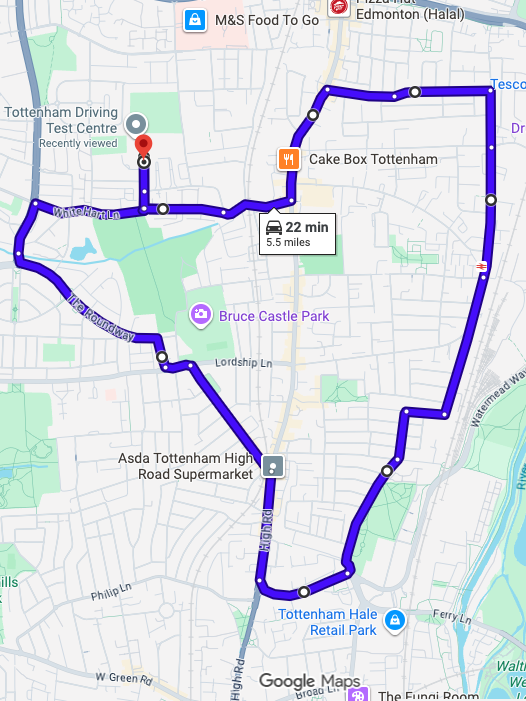
Master Tottenham Test Routes – Practise Instantly in Google Maps
✅ Know the Routes, Stay Calm – Familiarise yourself with real exam routes.
✅ No Setup Needed – Open instantly in Google Maps, no app required.
✅ Accurate & Up-to-Date – Verified to 2026 DVSA standards.
✅ Boost Your Confidence – Reduce anxiety before your test.
✅ Instant Access – Start practising immediately after purchase.
Are You Truly Test-Ready?
01.Can you drive for 40 mins without any instructor prompts?
02.Are you confident following Sat Nav signs toward Tottenham Hale Gyratory (A503?
03.Can you handle the Great Cambridge-roundabouts under pressure?
If yes, our Tottenham driving test routes can be a key part of your test preparation.
Tottenham Driving Test Centre: Frequently Asked Questions
What should I do if I make a mistake during my driving test?
Making a small mistake does not automatically mean you will fail. Examiners assess overall driving safety rather than perfection. Stay calm, continue driving safely, and focus on the next situation. Dwelling on one mistake often leads to further errors.
Which reversing manoeuvres might I be asked to perform?
During the driving test, you will be asked to complete one reversing manoeuvre. This may include parallel parking, reversing into a bay, or pulling up on the right and reversing for a short distance. Only one manoeuvre is assessed during the test.
How does the independent driving section work?
Independent driving lasts around 20 minutes and may involve following road signs, a sat nav, or a combination of both. You are assessed on safe decision-making rather than exact navigation. Taking a wrong turn will not result in a fail if you drive safely.
What are the Show Me, Tell Me questions?
Show Me, Tell Me questions check your basic vehicle safety knowledge. You will be asked one “Tell Me” question before driving and one “Show Me” question while driving. These questions cover topics such as lights, brakes, and windscreen functions.
Can I use my own car for the driving test?
Yes, you can use your own car for the driving test, provided it meets DVSA requirements. The vehicle must be roadworthy, insured for the test, and fitted with an additional rear-view mirror for the examiner.
How long do I need to wait before rebooking after failing a driving test?
If you do not pass your driving test, you must wait at least 10 working days before booking another test. This waiting period applies nationwide and allows time to reflect and prepare before retaking the test.
- Junction Observation: Failing to judge the speed of approaching vehicles at large roundabouts like Tottenham Hale.
- Mirror Usage: Not checking mirrors before changing direction or speed, particularly when exiting roundabouts or merging on the A503.
- Inappropriate Speed: Exceeding the 20 mph limit in school zones or failing to make adequate progress on faster 50 mph section
No, driving test routes from the Tottenham driving test centre do not include motorways
Confident Preparation for the Tottenham Driving Test Routes
Preparation is the enemy of anxiety. With our GPS-guided routes, your driving test feels less uncertain and far more familiar.
Get started with UK Route Master and practise the Tottenham driving test routes that matter most—starting today.